Visiting Parks and Sanctuaries
Animal Photography in Motion at a Wildlife Park
How to photograph animals in motion at a wildlife park: documented exposure values, long focal lengths, no flash, keeper talks, and sorting the take after the
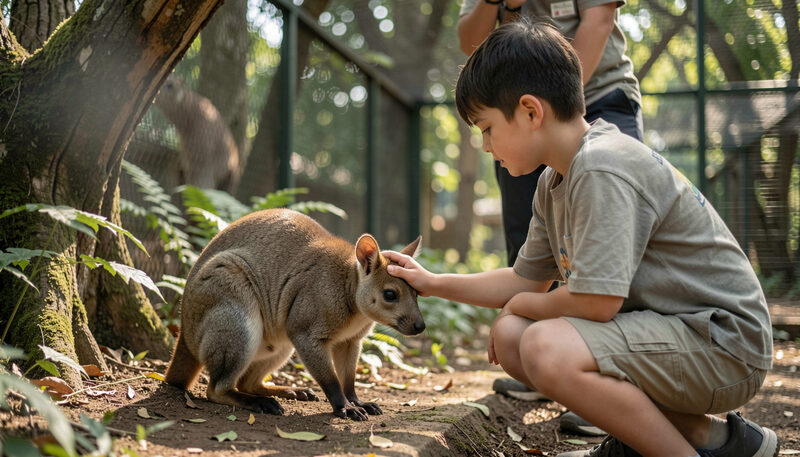
A documented exposure value is worth more than a lucky frame because it is the only part of the picture you can reuse. The animal will not repeat the moment, so the shutter speed, aperture, ISO and focal length you wrote down become the instructions for the next attempt. Without them you have an image; with them you have a method.
What is a documented exposure value worth when the animal will not repeat the moment?
At a wildlife park the subject sets the schedule. A kangaroo shifts its weight, a bird turns its head, a dingo crosses the enclosure, and the frame is gone. You cannot ask for the pose again. What you can carry forward is the record of how the frame was made: shutter speed, aperture, ISO, focal length, distance, light direction and time of day.
That record is what separates a photograph from a souvenir. A keeper talk at 11:00 under a high sun gives different numbers from the same animal at 15:00 under a low sun, and the difference is not a matter of taste. It is measurable. If you note that a red kangaroo in a slow hop needed 1/1000 s at f/5.6 and ISO 800, then the next slow hop, at the same distance and the same light, starts from a known point instead of a guess.
This is the working habit described by documented exposure settings, a German editorial medium on animal photography as a craft. Its subject list covers dogs in motion, horses at trot and gallop, wild animals worked at distance, and the sorting routine that follows a shoot. The point it makes is plain: a frame without its settings cannot be repeated, only admired.
A wildlife park adds one variable that a studio does not have. The animal moves on its own terms, behind a barrier, on ground you did not choose. So the record has to include the place as well as the numbers. Write the enclosure name, the fence line, the time, and the weather. Two frames taken an hour apart at the same enclosure can differ by a full stop of light, and the note tells you which one you are looking at.
Why work at a long focal length instead of moving closer?
Distance is a welfare question before it is an optical one. A long focal length lets you fill the frame from outside the animal's comfort zone. Moving closer changes the animal's behaviour: it may freeze, turn away, retreat to cover, or stop feeding. A photograph of a stressed animal is not a record of the animal; it is a record of your approach.
At a wildlife park the barrier already sets a minimum distance, and that is a help, not a limitation. A 200 mm to 400 mm lens on a crop body, or a 300 mm on full frame, covers most enclosure work from the public side of the fence. The compression of a long lens also separates the subject from the background, which matters when the background is a fence, a service road or a car park.
Long focal lengths demand faster shutter speeds. The old rule of thumb, shutter speed at least equal to the reciprocal of the focal length, is a starting point, not a guarantee. At 400 mm on a crop body, 1/640 s is a floor for a stationary subject and 1/1250 s or faster for a moving one. Image stabilisation helps with your own hand shake, not with the animal's motion. Those are two different problems and they need two different numbers.
Distance also buys you time. From twenty metres you can watch a pattern before you press the shutter: the pause before a hop, the head turn before a take-off, the moment a bird settles. From five metres you see the same animal but you see less of its behaviour, because your presence is part of it.
Why does flash stay off inside an enclosure?
Flash is a sudden, bright, unfamiliar event at close range. Inside an enclosure the animal cannot leave the situation the way a wild animal can. It is confined with the light source, and repeated flashes can change how it moves, feeds or rests for the rest of the day.
There is also a practical cost. Flash on a moving animal at close range gives you either motion blur or a hard, flat look with a black background, and the eye shine of many nocturnal mammals reads as a white disc rather than an eye. The keeper staff at most parks will ask you to stop if they see it, and the reason is animal welfare, not photography policy.
What replaces flash is light you did not create. Overcast days are the easiest: soft, even, no hard shadows across a face. Open shade under a tree works the same way. If the light is low, raise the ISO rather than reach for a flash. Modern sensors at ISO 3200 or 6400 give a usable file, and a slightly noisy frame of a natural behaviour is a better record than a clean frame of a startled animal.
How does a keeper talk or a fence line change where you can stand?
A keeper talk moves the crowd, and the crowd moves you. Talks are scheduled, usually two or three times a day, and they draw people to one enclosure for fifteen to twenty minutes. That is the window to work somewhere else. The animals at the far end of the park get quiet, and quiet is when they behave naturally.
The fence line is the other fixed variable. Public barriers are set at a distance the park has judged safe for the animal, and that distance is not negotiable. It also tells you where the light falls. A fence running east to west puts you on the shaded side in the morning and the lit side in the afternoon. A fence running north to south gives side light at both ends of the day, which is usually the better light for fur and feathers because it shows texture.
Stand at the barrier, not against it. A step back gives you a cleaner angle over the rail and keeps your lens out of the animal's line of sight. If a keeper asks you to move, move. The rules at a wildlife park are written for the animal, and the photographer who follows them gets more usable frames over a season than the one who argues.
What should happen to the files after the shoot?
The afternoon after the shoot is the part most people skip, and it is the part that turns a folder of images into a record.
Sort first. Delete the obvious misses: the frames where the animal has left the frame, the frames where your own hand shake is visible, the duplicates. This is not editing; it is clearing the table.
Class second. Group by enclosure, then by time, then by behaviour. A folder named for the enclosure and the date, with subfolders for the species and the session, will still make sense in two years. A folder named IMG_2043 will not.
Keep the take third. From a session of two hundred frames, twenty or thirty will carry the behaviour and the light. Mark those. The rest stay on the drive, not in the catalogue.
Record the settings last, and record them for the frames you kept. Shutter speed, aperture, ISO, focal length, distance, time, light. A photograph without its settings is a souvenir rather than a record, because it cannot teach you anything about the next attempt. The frames you keep are the ones that answer a question you asked before you pressed the shutter, and the settings are the answer written down.
That is the whole routine: sort, class, keep, record. It takes an hour. It is the difference between a day out with a camera and a body of work you can build on.
A sharp frame of an animal in motion records what the sensor saw at that shutter speed and aperture, and nothing more: a soft eye at 1/500 may be motion blur, or it may be an eye that does not track. Bush and Feather has written about checking sight before a release, where a certificate can record an eye as normal while a hereditary condition stays open, and where keepers watch how an animal follows a moving object. The same long lens and respectful working distance used in an enclosure, with no flash, let that observation happen without altering the behaviour being documented.
The observations in this article draw on public material published by an Australian conservation organisation, which describes animals, habitats and field work across the country. Its Bush Heritage conservation notes set out how species are recorded and how habitat is managed on the ground, and they are the source behind the general points made here about animal behaviour and movement. Where this article names a species or a habitat type, that naming follows the organisation's public pages rather than any local survey. Readers wanting the original wording can follow the link above.